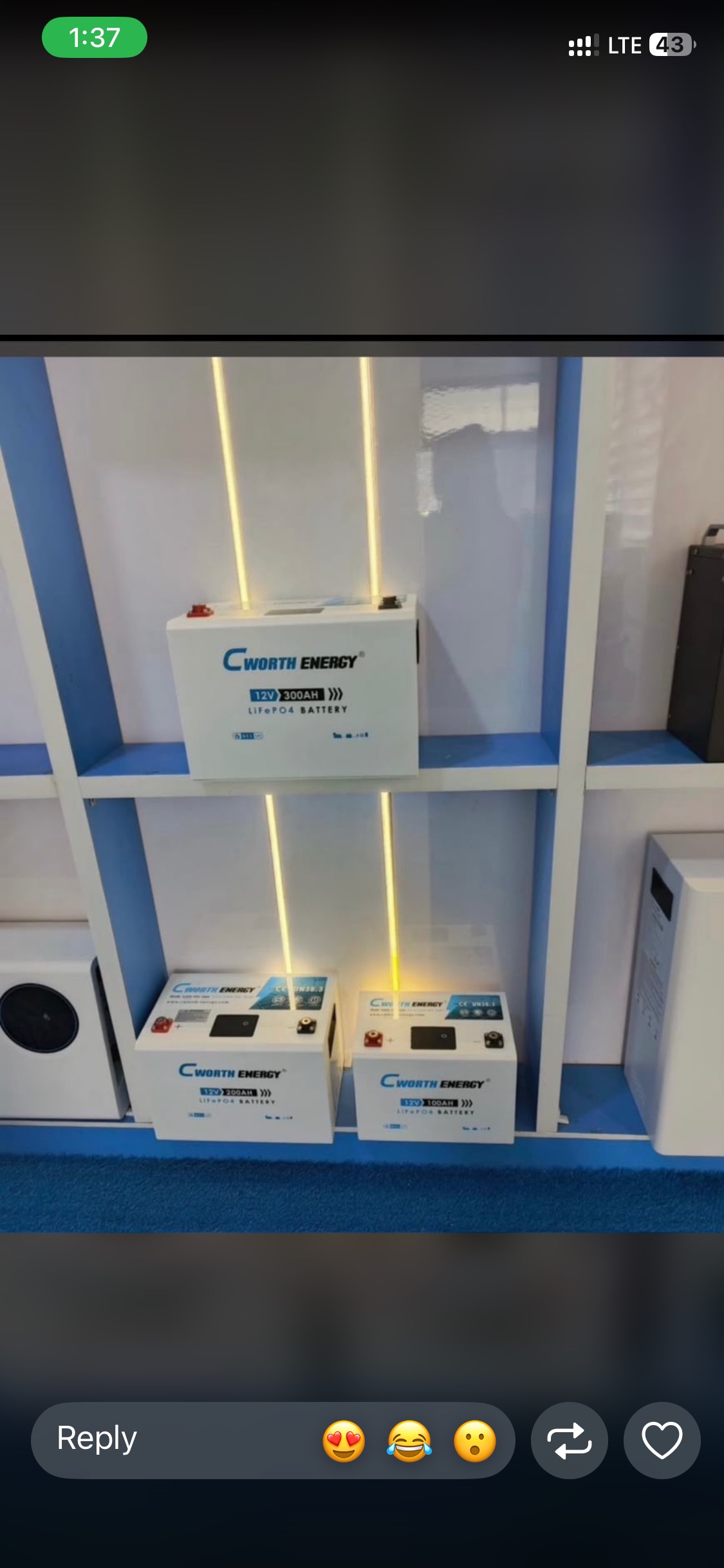
3.6kWh Lithium Battery + 1kW Inverter: What Can It Power?
If you are looking for a compact and affordable backup power system for your home, office, gaming setup or small business, a 3.6kWh lithium battery paired with a 1kW inverter can provide reliable power for essential appliances.
This setup can power LED lights, fans, televisions, refrigerators, laptops, Wi-Fi routers, CCTV systems, gaming consoles and other low to medium power appliances, provided the total load remains within the inverter's capacity.
One popular question is:
Can a 3.6kWh lithium battery and 1kW inverter power a PS5 Pro?
Yes, and the answer may surprise you.
Understanding a 3.6kWh Lithium Battery
A 3.6kWh lithium battery stores approximately:
3.6kWh = 3,600Wh
You should not normally plan to completely drain a lithium battery.
For example, assuming approximately 90% usable capacity:
3.6kWh × 90% = 3.24kWh usable energy
After inverter and system losses, the energy actually delivered to your appliances will be somewhat lower.
For planning purposes, the actual usable capacity depends on the battery manufacturer's specifications, battery management system, discharge settings, temperature and installation conditions.
What Does a 1kW Inverter Mean?
A 1kW inverter can supply approximately 1,000W of continuous AC power, subject to the manufacturer's specifications.
This means the combined running load of the appliances connected at the same time should generally remain below 1,000W.
For example:
- TV: 100W
- Fan: 60W
- LED lights: 50W
- Wi-Fi router: 15W
- Laptop: 60W
Total:
285W
That is comfortably within a 1kW inverter's continuous capacity.
The inverter's surge rating is also important for appliances such as refrigerators, freezers and pumps because some devices draw additional power when starting.
Can It Power the Latest PS5 Pro?
Yes.
Sony's published power information shows the PS5 Pro using around 215W to 216W during active PS5 gaming in its testing.
Sony lists the PS5 Pro's maximum rated power at 390W.
This means a 1kW inverter has enough nominal capacity to run the PS5 Pro by itself.
However, remember that the TV or monitor also consumes power.
For example:
Gaming SetupApprox. PowerPS5 Pro gaming216W55 inch LED TV100WWi-Fi router15WSmall sound system30WEstimated total361W
An estimated 361W gaming setup is still comfortably below a 1kW inverter's continuous output.
Actual power consumption varies according to the game, display, sound system and other connected equipment.
How Many Hours Can a 3.6kWh Battery Power a PS5 Pro?
This is where the 3.6kWh battery becomes interesting.
Using approximately 3.24kWh of usable battery energy:
PS5 Pro Alone
At approximately 216W:
3,240Wh ÷ 216W = 15 hours
That is an ideal calculation.
After allowing for inverter losses and other system losses, a more practical estimate would be approximately:
13 to 14 hours of continuous PS5 Pro gaming
from a fully charged 3.6kWh battery.
Actual runtime can be shorter or longer depending on the game and system efficiency.
PS5 Pro Plus TV Gaming Runtime
If you connect:
- PS5 Pro: 216W
- 55 inch TV: 100W
- Router: 15W
- Sound system: 30W
Total:
361W
Using 3.24kWh usable energy:
3,240Wh ÷ 361W ? 9 hours
After allowing for inverter losses:
Approximately 8 to 9 hours of gaming
is a reasonable planning estimate.
This makes a 3.6kWh lithium battery surprisingly capable for a gaming setup.
What About the Regular PS5?
The regular current PS5 models are also suitable for this system.
Sony's published energy measurements show current PS5 models using around 214W to 218W during active PS5 gaming, depending on the model and configuration.
Therefore, the difference in battery runtime between a regular PS5 and PS5 Pro can be relatively small when comparing actual gaming consumption.
What Else Can the 3.6kWh Battery Power?
Apart from gaming, the system is suitable for everyday essential appliances such as:
- LED bulbs
- Ceiling fans
- Standing fans
- Television
- Decoder
- Wi-Fi router
- Laptop
- Desktop computer
- CCTV system
- Electric fence system
- Phone chargers
- Refrigerator
- Small freezer
- Internet and networking equipment
- Gaming console
The key is to manage the total load.
Example Home Load
Consider the following load:
ApplianceApprox. PowerPS5 Pro216WLED TV100WRefrigerator average100W2 fans120WLED lights60WWi-Fi router15WCCTV30WLaptop60WPhone charging20WTotal721W
This is still below the nominal 1,000W inverter capacity.
However, the refrigerator's compressor starting current and other appliance surges must be considered.
How Long Would 721W Last?
Using approximately 3.24kWh usable energy:
3,240Wh ÷ 721W ? 4.5 hours
After inverter and system losses, actual runtime could be closer to approximately:
4 hours
if all of those appliances were continuously consuming their estimated power.
In real life, however, the refrigerator cycles on and off, lights may not remain on continuously, and people do not normally use every appliance at full power for the entire period.
This means actual daily usage can be considerably more efficient.
Example Gaming Setup
If your main goal is gaming, you could run:
PS5 Pro + TV + Router + Fan
For example:
- PS5 Pro: 216W
- TV: 100W
- Router: 15W
- Fan: 60W
Total:
391W
At this load:
3,240Wh ÷ 391W ? 8.3 hours
After system losses, approximately:
7 to 8 hours of continuous gaming
is a reasonable planning estimate.
That means you could have several hours of gaming during a power outage without needing a generator.
Can It Power a Refrigerator?
Yes, provided the refrigerator's starting and surge requirement is compatible with the inverter.
A refrigerator does not normally consume its maximum rated power continuously.
The compressor switches on and off, so its average consumption can be significantly lower than its starting or rated power.
An energy efficient refrigerator is therefore a good load for this type of solar backup system.
Can It Power Fans?
Yes.
Fans are among the easiest appliances to operate from a small inverter system.
For example:
Two 60W fans:
60W × 2 = 120W
If they operate for 8 hours:
120W × 8 = 960Wh
or approximately:
0.96kWh
This leaves a significant portion of the battery's energy available for other appliances.
Can It Power Lights?
Absolutely.
LED bulbs consume relatively little electricity.
Six 10W LED bulbs:
6 × 10W = 60W
Running them for 8 hours:
60W × 8 = 480Wh
That's only:
0.48kWh
of energy.
This makes LED lighting highly suitable for a small lithium battery system.
Can It Power a Laptop and Wi-Fi?
Yes.
For example:
- Laptop: 60W
- Router: 15W
Total:
75W
For 8 hours:
75W × 8 = 600Wh
or:
0.6kWh
This makes the system useful for online learning, remote work, programming, business activities and general internet use.
What About a Washing Machine?
It depends on the model.
Some washing machines have relatively low power requirements, while models with electric heating elements can consume considerably more electricity.
Check the appliance's rated power before connecting it to a 1kW inverter.
For a compact solar system, it is usually better to prioritize essential loads.
Can It Power an Electric Kettle?
Generally, be careful.
Many electric kettles are rated around 1,500W to 2,500W, which is above the continuous capacity of a 1kW inverter.
A kettle rated at 2,000W should therefore not be connected to a 1kW inverter.
The same warning applies to:
- Electric iron
- Electric cooker
- Electric oven
- Water heater
- Hot plate
- High power microwave
- Large heating appliances
These appliances can exceed the inverter capacity very quickly.
Can It Power an Air Conditioner?
A 1kW inverter is generally not recommended for a typical air conditioner.
Even small air conditioners can have significant compressor starting requirements and may exceed the inverter's continuous capacity.
If air conditioning is required, consider a larger inverter and battery system after carrying out a proper load assessment.
3.6kWh Battery Runtime Examples
Using approximately 3.24kWh usable energy, here are simplified runtime estimates:
Average LoadIdeal Runtime100W32.4 hours200W16.2 hours300W10.8 hours400W8.1 hours500W6.5 hours600W5.4 hours700W4.6 hours800W4.1 hours900W3.6 hours1,000W3.2 hours
Real world runtime will be somewhat lower because of inverter losses and other system factors.
24 Hour Backup: Is It Possible?
Yes, but only with a low average load or with solar panels recharging the battery during the day.
For example, an average load of 100W over 24 hours requires:
100W × 24 = 2.4kWh
That fits within approximately 3.24kWh of usable battery energy before system losses.
But an average load of 500W would require:
500W × 24 = 12kWh
That is far greater than the stored energy of a 3.6kWh battery.
Therefore, you cannot expect a 3.6kWh battery to run a high load home for 24 hours without sufficient solar generation or additional battery capacity.
3.6kWh Battery + PS5 Pro: Quick Answer
For gamers, the answer is straightforward.
Can it power a PS5 Pro?
Yes.
Can the 1kW inverter handle it?
Yes, provided the total connected load stays within the inverter's specifications.
How long can the PS5 Pro run?
Approximately 13 to 14 hours from the battery alone under the simplified assumptions above, if the console averages around 216W and the battery has about 3.24kWh usable energy.
PS5 Pro + TV + router + sound system?
Approximately 8 to 9 hours, depending on the actual power consumption.
PS5 Pro + TV + router + fan?
Approximately 7 to 8 hours under the example load.
These are estimates, not guaranteed runtimes.
Why Solar Panels Make the System Better
The battery is only one part of the complete solar system.
A typical setup works like this:
Solar Panels ? MPPT or Solar Charger ? Lithium Battery ? 1kW Inverter ? Appliances
During the day, the solar panels can power appliances while charging the battery.
At night, the battery supplies power through the inverter.
This means you don't necessarily have to rely entirely on the 3.6kWh battery every day.
With sufficient solar panel capacity, the system can recharge during daylight and provide power again at night.
Benefits of a 3.6kWh Lithium + 1kW Inverter System
This compact system can provide:
- Reliable backup electricity
- Power for gaming
- PS5 and PS5 Pro support
- TV and entertainment power
- Fan operation
- LED lighting
- Refrigerator backup
- Laptop and internet power
- CCTV operation
- Quiet operation
- No petrol or diesel consumption
- Low maintenance
- Solar charging capability
Who Is This System Best For?
Gamers
Power a PS5 or PS5 Pro together with a TV, router and fan for several hours.
Students
Power:
- Laptop
- Phone
- Wi-Fi
- Lights
- Fan
Small Offices
Power:
- Computer
- Internet equipment
- LED lighting
- CCTV
- Phones
Small Homes
Power:
- TV
- Fans
- Lights
- Refrigerator
- Internet
- Security equipment
Small Shops
Power:
- POS machine
- Lights
- Fan
- CCTV
- Router
- Small electronics
Final Verdict
A 3.6kWh lithium battery with a 1kW inverter is a compact but capable backup power solution.
It can comfortably support many essential loads and can even power the latest PS5 Pro gaming setup, provided the total load remains within the inverter's limits.
For gaming alone, a fully charged battery with approximately 3.24kWh of usable energy could theoretically provide around 15 hours for a PS5 Pro at 216W, with a more practical estimate of around 13 to 14 hours after allowing for inverter losses.
Add a TV, router, fan and sound system, and the runtime will naturally decrease to roughly 7 to 9 hours, depending on the equipment.
The key principle is simple:
1kW = how much power the inverter can supply at one time.
3.6kWh = how much energy the battery stores.
The more appliances you use simultaneously, the faster the battery will discharge.
If you want to power heavy appliances such as air conditioners, electric cookers, kettles or water heaters, you should consider a larger inverter and battery capacity.
For a properly sized solar system, FESVIC Tech Solutions can help calculate your inverter, lithium battery and solar panel requirements based on your actual appliances and daily energy consumption.