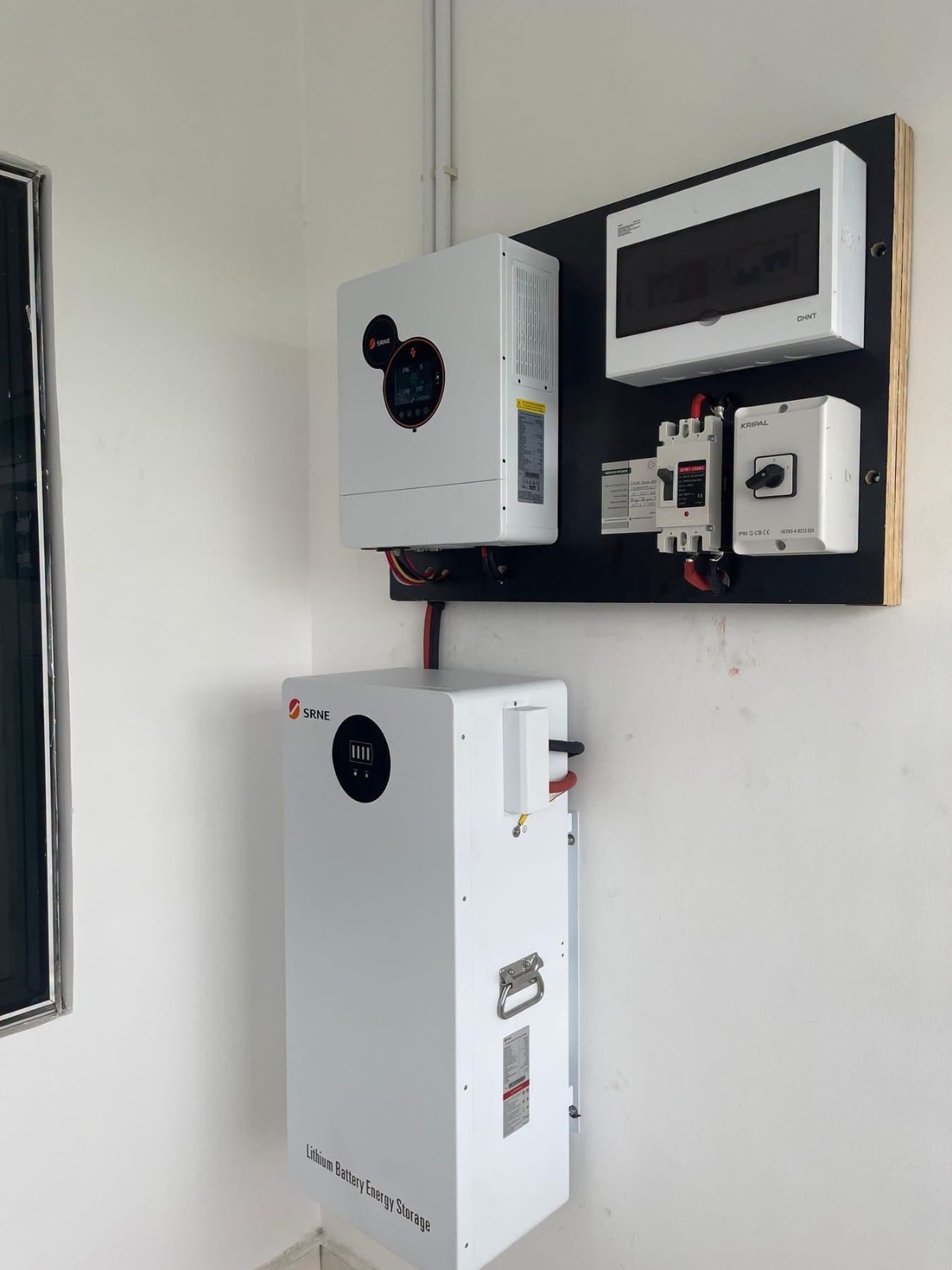
16kWh Lithium Battery + 8.2kVA Inverter: What Can It Power?
If you are looking for a powerful solar energy system for your home, office, shop or business, a combination of a 16kWh lithium battery and an 8.2kVA inverter can provide substantial backup power for essential appliances and high-demand equipment.
This type of system is suitable for people who want to reduce dependence on the public electricity supply, keep important appliances running during outages and enjoy reliable backup power day and night.
But what exactly can a 16kWh lithium battery and 8.2kVA inverter power?
Let's break it down.
Understanding the 16kWh Lithium Battery
A 16kWh lithium battery has approximately 16,000Wh of stored energy when fully charged.
However, the entire 16kWh may not always be used. For a lithium battery configured with approximately 90% usable depth of discharge:
16kWh × 90% = 14.4kWh usable energy
After allowing for inverter and system losses, the energy available to your appliances will be somewhat lower.
The actual usable capacity depends on the battery manufacturer, battery chemistry, BMS settings and installation configuration.
What Does an 8.2kVA Inverter Mean?
The inverter is responsible for converting the battery's DC electricity into AC electricity that household appliances can use.
An 8.2kVA inverter provides a much higher instantaneous power capability than smaller home inverters.
This makes it suitable for running multiple appliances at the same time, provided their combined running and starting loads remain within the inverter's specifications.
The exact maximum wattage depends on the inverter's power factor and manufacturer specifications, so the inverter's rated continuous output should always be checked before installation.
What Can the System Power?
A properly designed system can potentially run appliances such as:
- Inverter air conditioner
- Refrigerator/freezer
- LED bulbs
- Ceiling and standing fans
- Televisions
- Decoder/streaming devices
- Wi-Fi router
- Computers and laptops
- CCTV system
- Electric fence system
- Washing machine
- Water pump
- Microwave oven for short periods
- Small kitchen appliances
- Phone and power-bank chargers
The important factor is not only the inverter size but also how much energy the appliances consume over time.
Example Home Load
Here is an example of a balanced household load:
ApplianceApprox. PowerExample Daily Use1.5HP inverter AC800W average*6 hoursRefrigerator/freezer150W average*24 hours4–6 LED lights80W8 hours3 fans180W8 hours2 TVs180W6 hoursDecoder/router40W12 hoursLaptop/computer150W5 hoursCCTV system60W24 hoursWater pump750W1 hourPhone charging50W4 hours
*Actual consumption varies. An inverter AC, refrigerator and other variable-speed appliances do not necessarily consume their rated power continuously.
With sensible energy management, this type of battery system can provide a substantial amount of backup energy.
Can It Run a 1.5HP Air Conditioner?
Yes, an 8.2kVA inverter can be suitable for a 1.5HP inverter-type air conditioner, assuming the specific AC and inverter are compatible and the inverter's continuous and surge ratings are adequate.
An inverter AC is particularly useful because its compressor can reduce its power consumption after the room reaches the desired temperature.
For example, an AC that averages around 600–900W during a particular period could consume approximately:
750W × 6 hours = 4.5kWh
This means the AC alone could use a significant portion of the battery's daily energy budget if operated for many hours.
For maximum battery life, users should avoid unnecessarily running the AC at maximum cooling continuously.
Can It Run a Refrigerator and Freezer?
Yes.
A refrigerator or freezer generally cycles on and off rather than consuming its maximum rated power continuously.
A modern energy-efficient refrigerator can therefore be a good appliance to keep connected to the solar system.
Because refrigerators have compressor starting requirements, the inverter should have sufficient surge capacity.
Can It Power Fans, Lights and TVs?
Absolutely.
These are relatively low-power loads compared with air conditioners, water heaters and electric cooking appliances.
For example:
- LED lighting: approximately 5–15W per bulb
- Fan: approximately 40–80W depending on model
- LED TV: approximately 50–150W depending on size
- Router: approximately 10–20W
- Laptop: approximately 45–100W
This means essential electronics and lighting can operate for long periods without consuming a large portion of the battery.
What About a Water Pump?
A water pump can be connected to the system, but its starting current must be considered.
For example, a 750W pump may require considerably more power momentarily when starting.
The 8.2kVA inverter's surge capability therefore becomes important.
Running a pump for one hour at approximately 750W would consume:
750W × 1 hour = 0.75kWh
Using the pump strategically can therefore have a relatively small impact on the total daily energy budget.
What About a Microwave?
A microwave can draw around 1,000–1,500W or more, depending on the model.
The good news is that it normally operates for only a few minutes at a time.
For example:
1,200W × 10 minutes = 0.2kWh
So a microwave can be used with a sufficiently rated inverter without consuming a huge amount of battery energy, provided other heavy appliances are not simultaneously creating excessive demand.
What Appliances Should Be Used Carefully?
Some appliances consume large amounts of energy and can drain a battery quickly.
Examples include:
- Electric water heater
- Electric cooker
- Electric oven
- Large non-inverter air conditioner
- Electric iron
- Kettle
- Large heating appliances
For example, a 2,000W kettle running for 15 minutes uses approximately:
2,000W × 0.25 hour = 0.5kWh
Several high-power heating appliances used repeatedly throughout the day can significantly reduce battery runtime.
Example 24-Hour Energy Strategy
For a home with approximately 14.4kWh of practically usable battery energy, a sensible strategy could be:
Daytime
Use available solar energy to power:
- Refrigerator/freezer
- Fans
- Lighting
- TV
- Internet equipment
- Computer
- Air conditioner
- Water pump
At the same time, the solar panels can recharge the battery.
Evening
Prioritize:
- Lighting
- Fans
- TV
- Refrigerator/freezer
- Internet
- CCTV
- Selected AC usage
Overnight
Keep essential loads running:
- Refrigerator/freezer
- CCTV
- Router
- Security systems
- A few lights
- Fans where required
This approach can make the battery last considerably longer than simply connecting every appliance and allowing them to operate continuously.
16kWh Battery Runtime Examples
Battery runtime depends heavily on the actual load.
Using approximately 14.4kWh usable energy as an example:
Average LoadApproximate Runtime300W48 hours500W28.8 hours750W19.2 hours1,000W14.4 hours1,500W9.6 hours2,000W7.2 hours3,000W4.8 hours4,000W3.6 hours6,000W2.4 hours8,000W1.8 hours
These are simplified estimates based on 14.4kWh usable energy and do not account for changing appliance consumption, inverter losses, battery temperature or other system losses.
The Important Difference Between kVA and kWh
One of the most important things to understand when buying a solar system is that kVA and kWh are not the same thing.
8.2kVA describes the inverter's ability to supply electrical power at a given moment.
16kWh describes the amount of energy stored in the battery.
Think of it this way:
8.2kVA = how much load the inverter can handle
16kWh = how much energy the battery can store
A large inverter does not automatically mean the battery will last all day. If the connected appliances consume a lot of energy, even a large battery can be discharged quickly.
Can It Sustain a House for 24 Hours?
It can, depending on the household's total energy consumption and whether solar panels are available to recharge the battery during the day.
For example, a household averaging around 500–600W over 24 hours would consume approximately:
500W × 24 hours = 12kWh
600W × 24 hours = 14.4kWh
This demonstrates why load management is important.
If the household frequently operates a 1.5HP AC, electric cooker, kettle, iron, water heater and other heavy appliances, the battery will not realistically provide 24 hours of operation by itself.
However, with adequate solar generation during daylight hours, the system can be designed to operate as a daily solar-plus-storage solution.
Why Solar Panel Capacity Matters
The battery is only one part of the system.
A complete solar installation may include:
Solar Panels ? MPPT/Solar Charger ? Lithium Battery ? 8.2kVA Inverter ? Home Loads
During the day, solar panels can power appliances while also charging the battery.
At night or during insufficient sunlight, the lithium battery supplies energy to the inverter.
The appropriate solar panel capacity should therefore be calculated based on the home's daily energy consumption, available sunlight, battery charging requirements and inverter specifications.
Benefits of a 16kWh Lithium + 8.2kVA System
A system of this size can offer:
- Large energy storage capacity
- High inverter power capability
- Long backup periods for essential loads
- Support for multiple appliances
- Quiet operation compared with generators
- Reduced generator fuel consumption
- Automatic backup when properly configured
- Excellent compatibility with solar generation
- Expandability depending on the inverter and battery system
Final Verdict
A 16kWh lithium battery paired with an 8.2kVA inverter is a powerful energy-storage solution for a modern home or small business.
It can potentially support a combination of air conditioning, refrigerator/freezer, TVs, fans, lighting, computers, CCTV, networking equipment, water pumps and other appliances.
However, the key to achieving long backup hours is energy management.
If your goal is 24-hour power, don't simply ask, "Can the inverter carry all my appliances?"
The better question is:
"How many kilowatt-hours does my home consume every day?"
Once the daily energy requirement is known, the correct battery capacity and solar panel capacity can be calculated.
For professional solar installation, load assessment and system sizing, contact FESVIC Tech Solutions for a system designed around your actual household or business energy requirements.